Some links on this page are affiliate links. If you buy through one I may earn a commission, at no extra cost to you, and it never changes which tools make the list. As an Amazon Associate I earn from qualifying purchases.
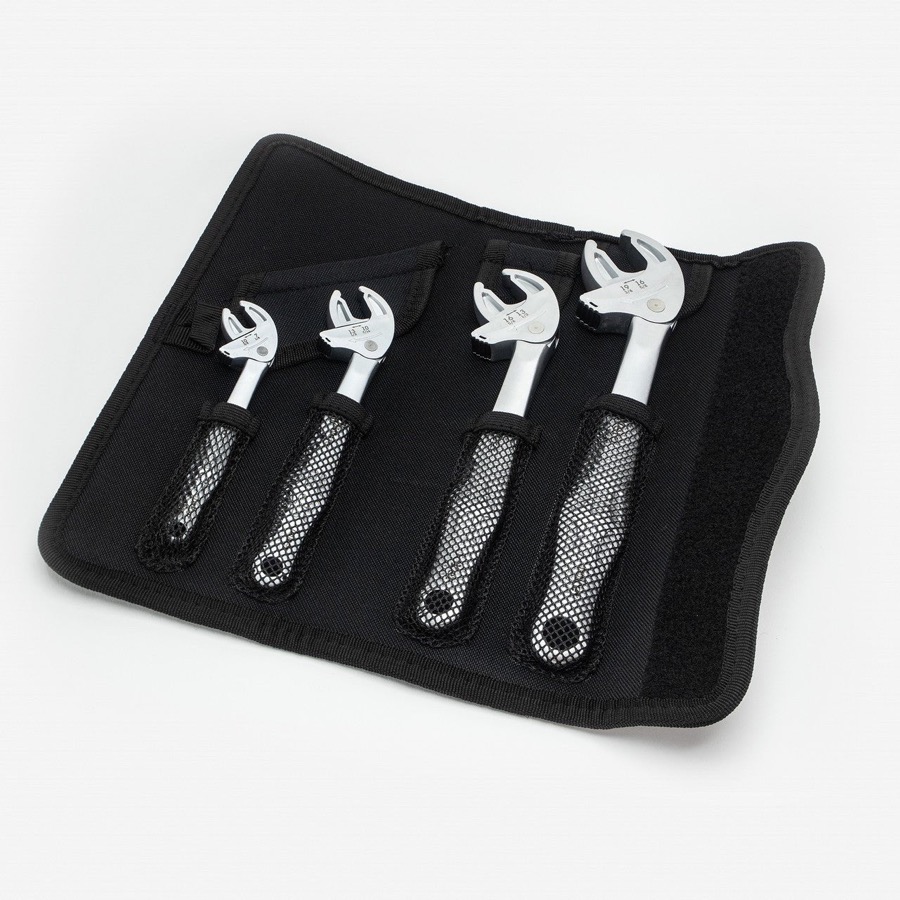
Wera calls these self-setting spanners. What that means in the hand: you push the open end onto a hex and the jaw sets itself to the flats. No sliding a knurl, no dialing a size, no hunting through a roll for the right wrench. One tool covers a range, and the four in this set cover 7 to 19 mm between them, metric and imperial both.
Two things make them more than a party trick. There’s a small lever in the jaw that clamps onto the bolt, so the wrench holds the fastener instead of dropping off the end the moment you let up. A plain open-end wrench grabs two corners of the hex and rounds them off when you lean on it. The Joker grabs the flats and holds, so it slips less and chews up less. And it ratchets: you don’t pull the wrench off and re-seat it every turn, you lift, swing back, and go again. The return angle is about 30 degrees, which is the part that earns its keep. That is a short arc. In the kind of tight, half-blind spot where you can’t fit a socket and can’t flip a regular open-end, this still turns the nut.
Where it stops: this is a setting-and-turning tool, not a breaker bar. For a seized fastener or real torque I still reach for a socket or the pliers wrench. But for the everyday work of getting onto a bolt fast without stripping it, the Joker beats a drawer of single-size open-ends, and the four of them fold into a pouch the size of a sandwich. Once you’ve used a self-setting wrench in a tight engine bay or the back of a machine, you stop wanting to go back.
View on Amazon Amazon